
What we showed
Our magnetic resonance technology delivers fully penetrative mineral content measurements on conveyor in real time to enable bulk ore sorting, diverting barren material before it reaches the mill and achieving higher feed grades.
Conversations on the stand kept returning to three points:
- Speed. The MR analyser returns a grade measurement every 4–10 seconds. That is fast enough to decide the destination of pods of a few tonnes, rather than averaging grade across thousands.
- Penetration. MR reads the full bed depth of crushed ore on the belt, not just its surface, with no washing, screening or drying.
- Safety. There is no radioactive source, so no radiation licensing is required.
None of this is a prototype claim. An MR analyser runs on a 6,000 tph crusher discharge belt at Candelaria in Chile, and another ran at 2,800 tph at Kansanshi in Zambia, the largest publicly reported sensor-based bulk ore sorting installation worldwide.
A visit from the Minister for Resources
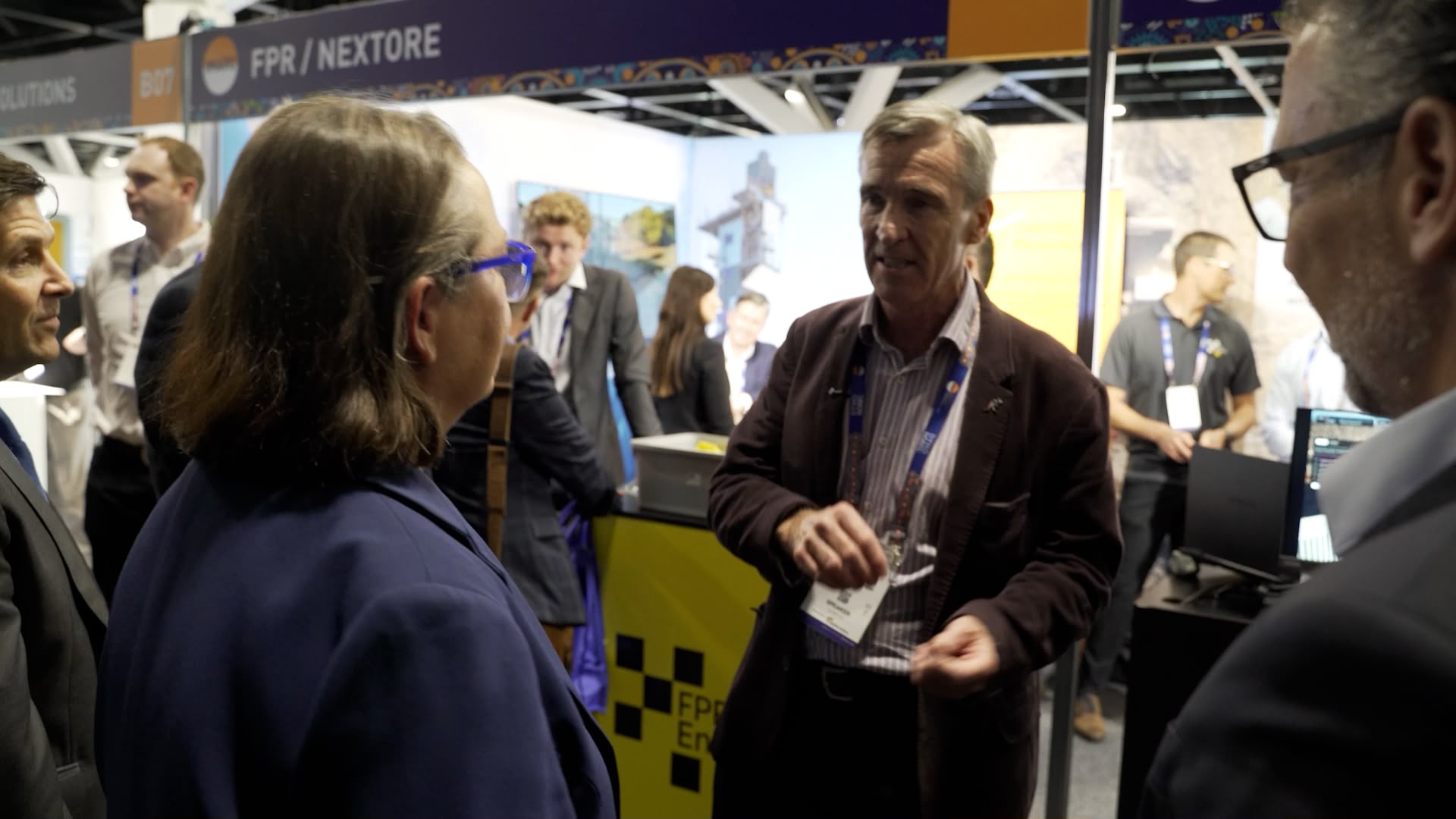
On day two, Minister for Resources Madeleine King visited a limited number of stands, NextOre’s among them. It was a chance to show how an Australian sensing technology helps miners get more value from every tonne they already move.
On stage
IMARC 2026 gave us three speaking appearances. On Tuesday 27 October, NextOre Strategic Advisor Alex Mayer presented Fast, accurate data and the decision tied to every tonne. The next day he joined CSIRO’s Breakthrough to Business: The Partnerships Powering Mining Innovation session, presenting and sitting on the panel alongside Portable PPB, Quantum and Labwest. MagnaTerra CEO John Shanahan also presented Same playbook, different battlefields with Rob Adamson of RFC Ambrian.
From the stand to the workshop
Delegates were also invited to see the technology at our Rydalmere facility in western Sydney, where MR analysers are assembled, tested and calibrated before they ship to site.
What comes next
“IMARC is where Australia’s mining industry meets its own technology base. This year the questions were less about whether magnetic resonance works and more about where it fits in the flowsheet. That is the shift we have been working towards.”
The team is now following up with the operators and project teams who asked for technical papers, heterogeneity assessments and site-specific sorting studies. NextOre’s next stop is Minexcellence 2026 in Santiago, from 24 to 26 November.
Frequently asked questions
What is magnetic resonance ore sorting? It uses radio-frequency pulses tuned to a target mineral, such as chalcopyrite, to measure grade on a moving conveyor in seconds. Each pod of ore is then sent to the mill or to waste.
Does NextOre’s technology use a radioactive source? No. MR uses non-ionising radio waves, so no radioactive source management or radiation licensing is required.
Where can I see an MR analyser? At our Rydalmere facility in Sydney. Contact the team to arrange a visit.