
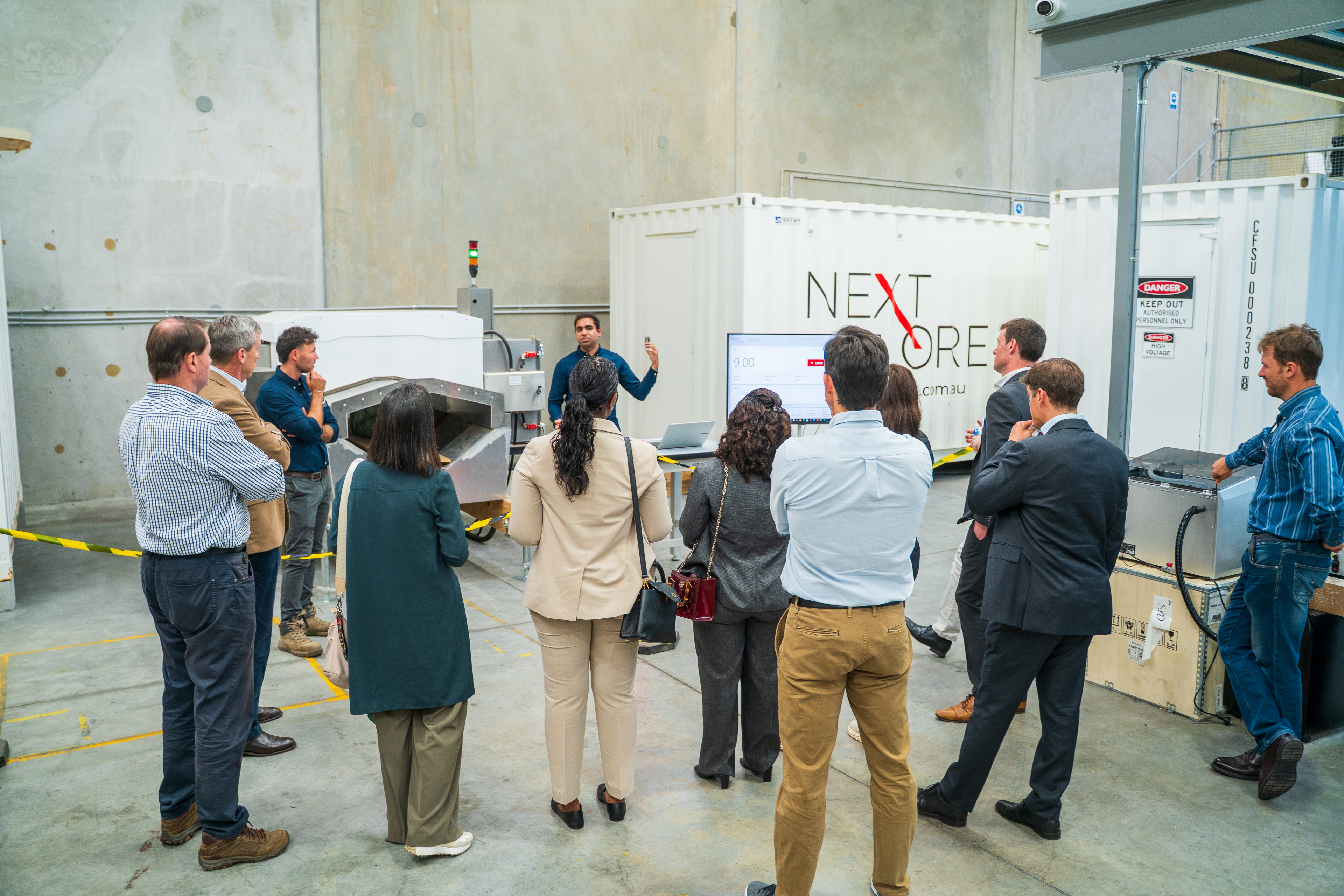
From CSIRO science to a working instrument
NextOre’s MR technology is the result of decades of CSIRO research. The workshop is where that science becomes hardware: analysers are assembled, tested and calibrated in Rydalmere so they work on day one at site.
Each analyser is engineered for the site that will use it, matched to the ore’s dominant mineralogy, the conveyor design and the belt width.
How the measurement works
The analyser pulses radio waves into the moving ore, tuned to the resonant frequency of one target mineral, such as chalcopyrite in copper ore. Only that mineral responds. The strength of its signal tracks the mass of the mineral in the ore, and a belt scale supplies the total tonnage, so the two together give the grade.
Because resonant frequencies for different minerals rarely overlap, the reading is not confused by the rest of the rock, by moisture or by particle size. Visitors saw why this matters for calibration: each unit is calibrated once in the factory with a single factor, confirmed at commissioning against a known sample of the mine’s own ore, and never routinely recalibrated.
Built to fit the belt you already have
The sensor is made in upper and lower halves that wrap around an existing conveyor without cutting the belt. Its electronics sit in a standard 10-foot container within 10 metres. A well-planned 12-hour shutdown is the typical installation window. At Kansanshi, site personnel installed the sensor within that window under remote direction from the Sydney team during COVID travel restrictions.
Safe by design
MR uses non-ionising radio waves. There is no radioactive source, so no radiation licensing is required, and no exclusion zones or radiation safety officers.
Beyond the conveyor
The same technology is being applied to underground haul trucks, so ore can be assessed before it travels to the surface.
“Most of the industry has read about magnetic resonance; very few have stood next to an analyser. Seeing how it is built and tested answers questions a brochure cannot.” – Nick Cutmore, CTO.
Visit our lab
The Rydalmere facility is open to mining companies, engineering partners and researchers by appointment. If you are evaluating sensor-based sorting, the most useful hour you can spend is in front of the equipment.
Frequently asked questions
Where are NextOre’s MR analysers built? They are assembled, tested and calibrated at our facility in Rydalmere, NSW.
How long does installation on an existing conveyor take? A well-planned 12-hour shutdown is typical across NextOre installations.
Does the analyser need regular recalibration? No. It is factory calibrated, confirmed at commissioning, and needs no routine recalibration.